
The Ecosystem · 2025–present
Prisma
One model is one perspective, trustworthy answers come from triangulation, not from a single confident voice.
A desktop companion that refracts one situation through eight lenses and two models, and hands back the disagreement intact.
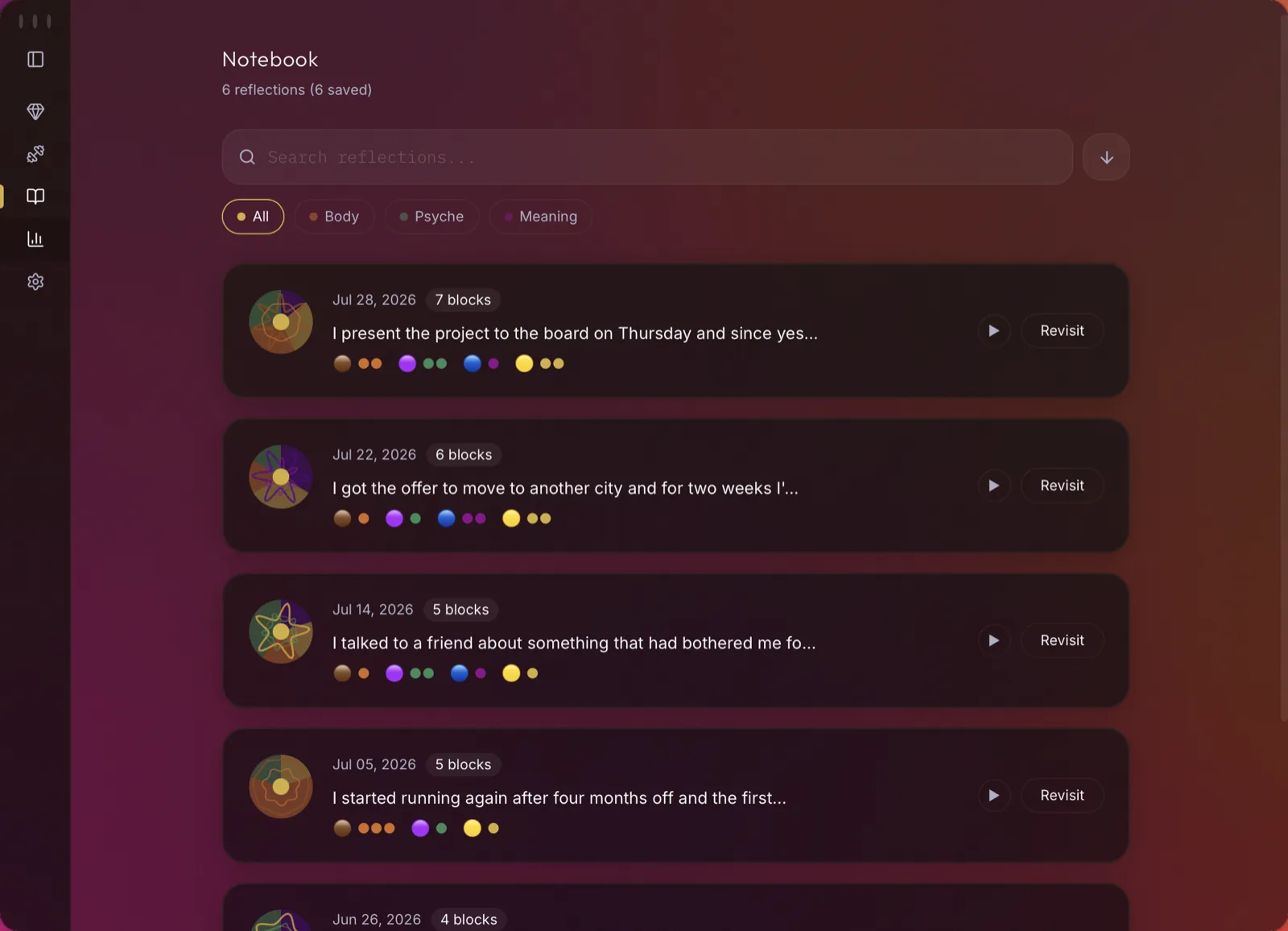
Prisma's Notebook, six reflections listed with the date and block count of each, every one carrying a mandala that encodes which dimensions and perspectives it drew on.
The single lens
Every way of looking is also a way of not seeing.
A situation you are actually living is composite. It has a bodily register, an emotional one, a pattern that has happened before, and a question about meaning underneath all of it. Every school of thought that could read it has its own episteme and its own blind spots, and so does every model you might ask. The failure is the same at both levels: one instrument, presented as the whole picture.
-
The specialist's instrument
Cognitive therapy sees a thought pattern, Gestalt sees what you are avoiding right now, analytical psychology sees a symbol. Each is genuinely right about its own facet and silent about the others. And none of them tells you which instrument you happened to be holding.
-
The model has a temperament
A language model has characteristic emphases and characteristic omissions, the way a person does. Ask one and you inherit its disposition invisibly, mistaking the shape of the answerer for the shape of the question.
-
Blending destroys the evidence
The obvious fix is to ask several sources and merge what comes back into one smooth summary. That is the worst available option: consensus manufactured by averaging, with the disagreement deleted at exactly the point where it was carrying information.
-
Fluency reads as correctness
One voice, well written, is indistinguishable from one voice that is right. The prevailing interface answers in a single register of confidence regardless of how thin the ground is, which is an epistemic claim it has no way to back.
-
Thought that never reaches the body
The problem is rarely thinking too much. It is thinking without feeling and without listening to the body, while the analysis runs on perfectly well by itself. Nothing in an ordinary conversation is built to notice that the three have come apart.
-
It ends when you close it
Reflection stops at the moment of understanding. There is no act small enough to actually perform tomorrow, and no structure underneath it, so the hundredth reflection is no wiser than the first.
What one lens costs
The refraction
There is no view from nowhere. There can be several views, kept apart.
A prism adds nothing to light. It decomposes it, and the components were there the whole time. The design follows from that image literally: refract the same question, never merge what comes back, and treat the places where the readings separate as the most informative thing on the page.
The synthesis curates, it never blends. Where the readings converge, that is evidence. Where they diverge, both are kept, named, and attributed.
The second reframe: the body is the densest part of the psyche
The lenses are not a flat list of schools. They are laid along a continuum from dense to subtle, from body through psyche to meaning, with sensation and action at one end, pattern and emotion in the middle, purpose and symbol at the other. The gradient is borrowed from traditions that have always modelled a person that way, and it is used here for an unmystical reason: it keeps the somatic voice in the room when the cognitive one is doing all the talking.
So every synthesis ends up asking a fourth question that no individual lens would think to ask. What did the body register, what did the affect want, what did the analysis conclude, and where did the three stop informing each other? That decoupling is usually the finding. Cognition is seldom the thing that failed; it is the thing that carried on working alone.
A fourth position on the spectrum is reserved for the person. Their own reading of the situation sits alongside the eight as an equal, illuminated by them and replaced by none of them.
What the spectrum shows
The output is typed, and most of its types are disagreement
A reflection does not come back as prose. It comes back as blocks, each labelled with what kind of finding it is, which dimension it belongs to, and which lenses produced it. The typing is the whole argument. It makes agreement and disagreement structurally different objects rather than two tones of the same paragraph.
Convergence
Three or more lenses arriving at the same observation from incompatible starting assumptions, on two different models. This is the only kind of confidence on offer here, and it is worth something precisely because the lenses were never built to agree.
convergence
Productive tension
Two readings that contradict each other and are both defensible. The block names the disagreement and declines to settle it. A voice telling you to make a plan and a voice telling you to stay in the present moment do not reduce to one instruction. Flattening them loses the actual choice in front of you.
tension
The blind spot
Something exactly one lens saw. Credited by name, and impossible to produce any other way, since it exists only as the residue of having run all the others. In a system tuned for consensus this would be discarded as noise. Here it is the line most worth reading.
blind_spot
Where it came apart
One block per reflection maps the decoupling: what the body registered, what the affect asked for, what the analysis concluded, and the point at which they stopped speaking to each other. It is written every time, whether or not the question appeared to be about the body at all.
soma_afeto_cognicao
Something to do by tomorrow
A micro-commitment scoped to twenty-four hours, drawn from the five Reiki principles, alongside whatever practical work the lenses proposed. These are extracted into a store you can tick, annotate and look back through, which is what turns advice into a record of what you actually tried.
gokai · homework
The reading, read back
A closing observation about the analysis itself: which lenses dominated this one, what shape the disagreement took, what the composition of the spectrum says. The system is asked to be legible about its own behaviour, not only about yours.
meta_observation
Architecture
The part that routes is not allowed to have an opinion
Two structural decisions carry most of the argument. The first is that refraction happens along two axes rather than one. The second is that dispatch and judgement are separate components on purpose, so that neutrality is a property of the architecture instead of a promise made in a prompt.
Two axes of refraction
Most multi-model setups vary the model and hold the prompt fixed. Most multi-perspective setups vary the prompt and hold the model fixed. Doing both at once makes the two sources of variance separable: when two lenses diverge on both models, that is a real difference between two ways of looking, and when one lens diverges from itself across models, that is temperament, and it can be discounted accordingly.
Both models are reached through the command-line tools of subscriptions already being paid for rather than through metered APIs. A small plumbing decision with a large consequence: asking the same question sixteen times is only a reasonable design if the sixteenth answer costs nothing extra.
One reflection, end to end
The situation is enriched before any lens reads it, with earlier reflections from the notebook, and, when the recovery system is connected, with the clinical context that would otherwise be missing from a conversation about the body. Then it goes to every enabled lens simultaneously and returns to a curator whose only instruction is to organise without homogenising, and never to pick a winner.
The result is not a report. Any block can be replied to, and the reply is routed back to the specific lens that wrote it; the block updates in place and the disagreement is allowed to move. A reflection is a structure you can argue with, which is a different kind of object from a page of advice.
The substrate
Reflections are journal entries. They are written as YAML files into a directory on the machine that produced them and they go nowhere else: no account, no sync, no server holding them on your behalf. Everything the interface shows is a file you can read, move or delete without asking the application.
Above that sit five surfaces in one desktop window, and a mandala generated deterministically from each reflection's own composition, so that a year of them can be told apart at a glance before a single word is read.
- Reflectionthe situation goes in, the spectrum comes back
- Practicethe twenty-four-hour commitments, ticked and annotated
- Notebookevery reflection, searchable and revisitable
- Patternswhat recurs, what worked, which lenses land
- Contextwhich lenses are on, which models, what else is connected
The record
One reflection is an answer. A hundred is a portrait.
Here the argument stops being about any single question. Because the blocks are typed, the dimensions recorded and the practices carry whether you actually did them, the notebook is structured enough to be read as data. And what it says is the part no individual reflection could ever have told you.
What comes back from that accumulation is deliberately unglamorous. Recurring themes, counted across everything you have written, which is the first honest answer to what has actually been on your mind. What worked, drawn not from what was proposed but from the commitments you ticked and the notes you left on them. Which lenses land: some approaches produce insight for one person and bounce off another, and after enough reflections that stops being a matter of opinion. And the drift: the dimension you have been living in, tracked over months. All of it is computed locally with nothing more exotic than word counting, because a claim about your own year should not require sending the year anywhere.
Practices can be sent onward to Halo, the recovery system, where they are appended to that day’s record and tagged with where they came from. The context flows the other way too: a reflection written during a difficult week has the clinical situation attached before any lens reads it, which is the difference between advice about a body in general and advice about this one.
A note on the name, because it is shared. PrismDB began as Prisma’s retrieval engine and is now a separate repository making a separate argument. Prisma refracts an opinion: one question, many readers, disagreement preserved. PrismDB refracts a record: one row, many fields, each given the retrieval strategy its own kind of data deserves. The same image serves both, and they resolve it in different domains. Neither is a component of the other.
Prisma is not therapy and does not pretend to be. It does not diagnose, it does not prescribe, and it never returns a verdict. The eight readings are handed over with their contradictions intact and the resolution left where it belongs. That is the uncomfortable part of the design and also the point. An interface that presents one voice as truth has made a claim about knowledge it cannot support; the honest alternative costs the reader something, because a spectrum takes longer to read than a paragraph and asks you to sit with two things that cannot both be acted on.
This is the studio’s honesty principle turned into infrastructure. Where the readings agree, confidence has been earned. Where they diverge, the divergence is itself the finding, a mark saying here, look closer, nobody is going to settle this for you. Triangulation is what intellectual humility looks like once you have to build it.