
The Ecosystem · 2026–present
Compass
A job search is cognitive overload at scale, externalize everything except decisions and presence.
A desktop system for running twenty parallel job searches without carrying a single one of them in your head.
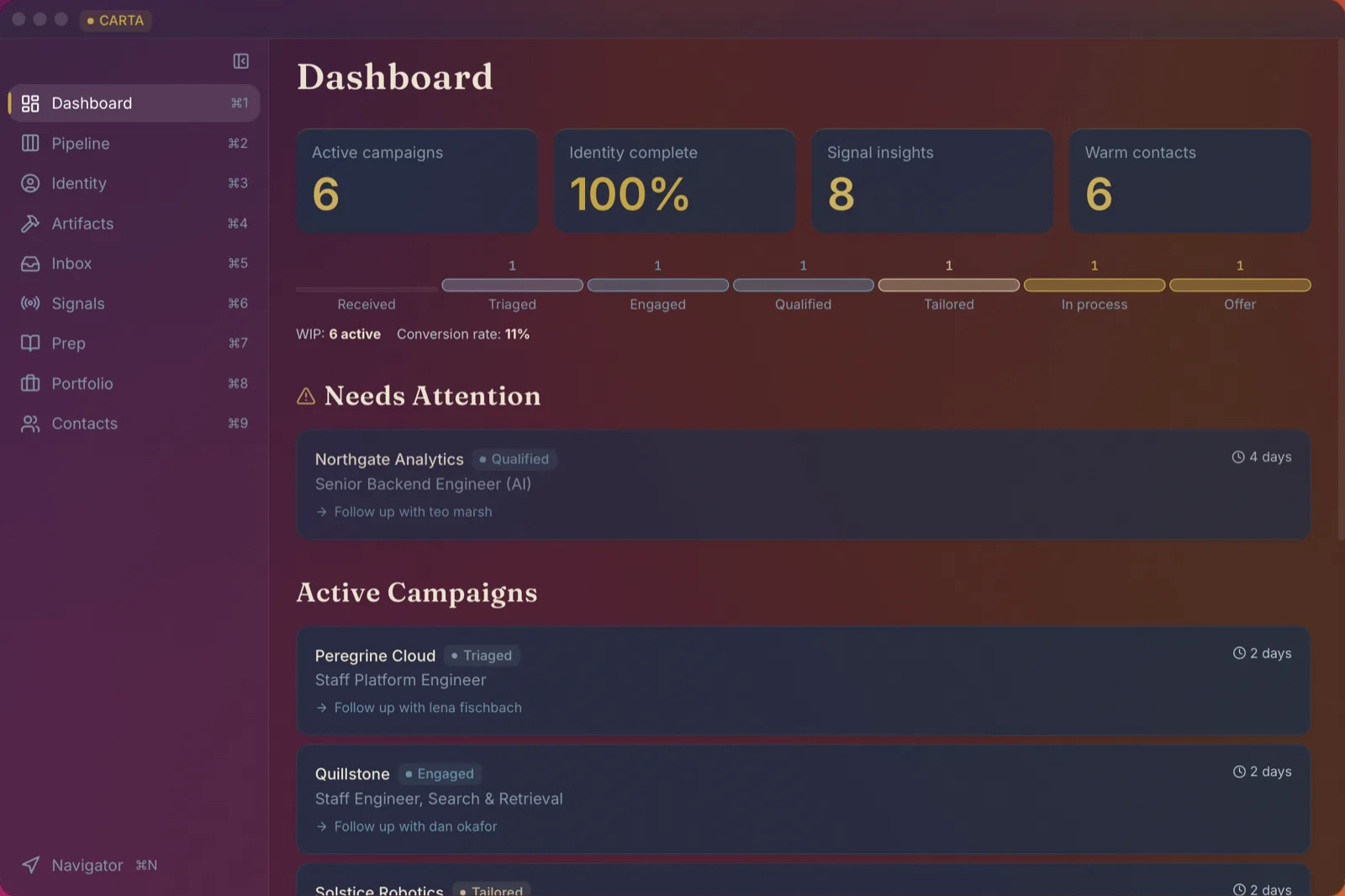
Compass's Dashboard, KPI tiles for active campaigns and warm contacts above a pipeline funnel and a list of opportunities needing attention.
The load
Searching for work is not hard. It is wide.
No individual task in a job search is difficult. Reading a job description, writing a letter, answering a recruiter, remembering to follow up: each is fifteen minutes of ordinary work. What breaks people is holding twenty of them at once, each its own universe of company, people, artifacts and deadlines, all of it in one head.
-
Context switching
Seven or more processes run in parallel, each with its own company, job description, recruiter, stage and artifacts. Moving between them costs more than the work inside any one of them.
-
Research done by hand
Companies expect to be known intimately. That research is manual, so it is either overdone for one company or quietly abandoned for the next.
-
Tailoring, every time
Job descriptions are inflated and usually mix three roles into one. Twenty-one years is too much material to send as-is. Each vacancy needs its own reading, its own résumé, its own letter.
-
Data scattered by channel
Job descriptions arrive by hand, interview notes are taken by hand, and the conversation lives across LinkedIn, email and WhatsApp with no single history.
-
Asymmetric communication
Companies send templates and expect personal replies. Follow-ups are forgotten. People who took the time to write are left without an answer.
-
Nothing is remembered
Interviews are the best market research available anywhere, and their content evaporates. The signal was never in the rejection email. It was in what the interviewer chose to probe.
The contradiction underneath
The reframe
You cannot lower the volume. Only the cost.
The number of live campaigns is set by how hiring works, not by preference. The only remaining variable is what each one costs to keep alive. And almost none of that cost is the part that decides the outcome.
The human spends themselves on decisions, and on presence in the room. Research, tailoring, tracking, drafting and memory belong to the system.
The second reframe: the front door is an inbox
Almost nothing here begins with an application. Opportunities arrive inbound: a recruiter found you, and wrote. Designing for that reality changes what the system is. The front door is an inbox rather than a job board, and the first artifact a pursuit produces is a reply, not a résumé.
It also changes which entity is permanent. A recruiter is not a vacancy. They are a channel that may carry five of them over two years. So contacts outlive campaigns, and every message is answered, including the declines, which are written to keep a door open rather than close it.
What the system carries
Six things that leave your head and do not come back
Each of these is delegated for the same reason: it is preparation, not judgement. The system assembles material; the decision stays with the person. Wherever that line blurs, whether a message going out under your name or an offer to weigh, the work stops at a draft and waits.
Triage at the front door
An inbound message is read against your identity and comes back classified as engage, ask for more, decline, or simply stay in touch, with a reply already drafted and the sender resolved to a contact you may already have history with. Legitimacy heuristics gate email before any of that runs, so scams never reach triage.
recruiter-inbox-agent · telegram-bot
Research you never had to request
The moment a company is named, a profile is written: product, stack, engineering culture, size, funding, how they run their interviews. It is cached and reused, because companies recur across opportunities even when the vacancies do not.
company-researcher
Tailoring from a single truth
Experience lives once, in one curated plane, with evidence attached to every skill. A job description is parsed into what is genuinely required, what is optional, and what is inflated, then scored against that plane. The résumé, letter and value proposition are generated from the intersection rather than from a template.
jd-matcher · artifacts-maker · resume-maker
Prep as assembled context
Before an interview the system gathers what you would have gathered by hand: the company, the parsed role, the experiences that actually match it, and the questions companies of this shape have asked before. That last source exists only because earlier interviews were captured.
prep · signal
The room, kept
Interviews are recorded, transcribed and read for what was asked rather than for a verdict: questions by category, recurring themes, and the gaps that got exposed. Company feedback is rare and shallow; the questions are neither.
transcript-recorder · transcript-importer
Follow-up that does not depend on remembering
A daemon watches for what has gone quiet: a promised résumé, an unanswered thread, a pursuit aging without contact. It surfaces each one with a draft attached. Attention becomes something the system spends on your behalf.
follow-up · event-scanner · proactive-decision-engine
Architecture
Three planes, and a campaign that is allowed to die
The shape of the system follows the shape of the problem. One thing about you is permanent. One thing about each opportunity is disposable. And something has to keep the whole fleet visible without demanding vigilance.
Three planes
Most job trackers model the vacancy and attach you to it. Compass inverts that. Identity is singular and persistent, curated once and consulted constantly: experience, skills with evidence, positioning angles, portfolio, deal-breakers. A campaign is generated from it, never typed into it.
That inversion is what makes tailoring cheap. Filtering twenty-one years down to the eight lines one vacancy needs becomes a query against a plane that already exists, instead of an act of memory performed at eleven at night.
One opportunity, end to end
The route is deliberately cheap at the front. Triage takes seconds and happens before any deep work, because most inbound messages should not become campaigns. And the ones that should not still get an answer. Only once a job description arrives does the expensive work begin.
Closing is a first-class stage rather than a deletion. Won or lost, a campaign writes a retrospective, and the retrospective is where market intelligence comes from. A loss that yields a signal is not a wasted month.
The substrate
There is no database. Every plane is YAML and markdown on a filesystem, readable without the application, diffable in git, still legible in ten years when whatever renders it has been replaced twice. A career is a long-lived record; it should outlive its tooling.
Above that sit around thirty small command-line tools, each doing one thing, grouped by what they are for. A conversational agent reads across all of them. A desktop application renders the same files as a chart room.
- intakejob descriptions, match scoring, interview capture
- researchcompany and contact intelligence
- generationrésumés, letters, portfolio, prep packs
- channelsinbox, calendar, approvals
- pipelinethe campaign state machine and its orchestration
- daemonthe part that notices things without being asked
- signalwhat accumulates across everything above
What compounds
Campaigns are disposable. What they leave behind is not.
This is the whole difference between a tracker and a system. A tracker's data dies with the row it lived in. Here the campaign is the ephemeral thing, and the planes underneath it get denser every time one closes.
Every campaign that ends leaves three deposits. Signals: the questions that were actually asked, filed by category and counted, so the third time a subject appears it stops being a surprise; the patterns that separate what a job description says from what a company wants; the gaps between what is being asked for and what the identity plane can evidence, which is a study list, not a verdict. Contacts: the recruiter who brought a poor vacancy in March may bring the right one in November, and when they write again the history is already there. Identity: sharpened by whatever turned out to matter.
This is the answer to the last pain on the list, the one with no workaround, and the reason the system is worth building rather than merely using. Nothing lived is thrown away. The seven months are not a gap to explain later; they are an accumulating body of market intelligence that makes month eight cheaper than month one.
When a campaign finally closes as won, the intelligence gathered along the way is not discarded either. Working hours discussed in a screening, the communication rhythm observed across the process, the team structure, the delivery expectations: these are written into a profile in Continuum, the ecosystem that runs the work itself. Compass exists to get the work, Continuum to do it, Ciclus to sustain the person doing both. The handoff is not an export; it is a transfer of what was learned.
What the person is left holding, in the end, is a chart room rather than a backlog. Calm, oriented, quietly accumulating knowledge on the traveller’s behalf, and asking of them only the two things a system genuinely cannot do: decide, and be present in the room.